
RELATED STORIES:
(1) Antonio Lima-de-Faria: The Law of Biological Periodicity; (2) Antonio Lima-de-Faria: “Stave Off” Deadly Obscurantism; (3) Mechanobiology/Atomic Biology Nexus: Natural Selection Dispose[d] Of; (4) A. Lima-de-Faria: Autoevolution, Atoms to Humans; (5) Happy 100th Birthday! Antonio Lima-de-Faria; (6) Happy Birthday 102! Antonio Lima-de-Faria

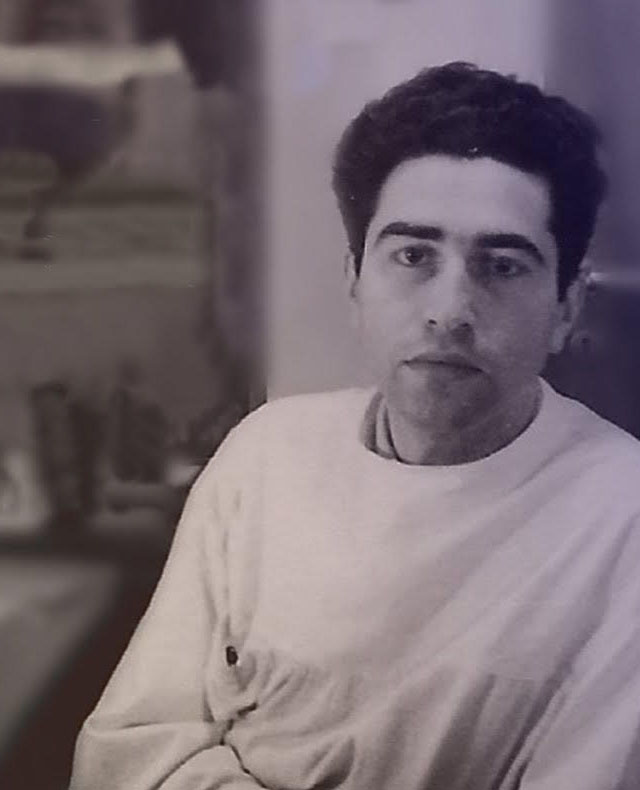
Beloved evolutionary scientist Antonio Jose Cortesao Pais Lima-de-Faria died on December 27 at age 102. Born in Cantanhede, Portugal July 4, 1921, Lima-de-Faria moved to Sweden in 1950 following his undergraduate studies in Lisbon immediately after WWII. In Sweden, he began a life-long affiliation with the University of Lund where he received his PhD in genetics, taught cytology and later molecular cytogenetics; he also established and for 20 years directed the university’s Institute of Molecular Cytogenetics.
In 1974, A. Lima-de-Faria was decorated “Knight of the Order of the North Star” by Sweden’s King Carl XVI Gustaf for his contribution to science. Lima-de-Faria was a highly independent thinker, however, and considered his voice that of “a lonely wolf howling in the immensity of the night sky.” Nevertheless, his was a cry heard around the world. Antonio Lima-de-Faria was one of the last of his generation’s noble men of science.
I was intrigued by his vivid book, Evolution Without Selection and asked Antonio for an interview in 2008 for my book,The Altenberg 16: An Exposé of the Evolution Industry.
Antonio’s perspective was that Darwinism and neo-Darwinism had been useful in pulling science out of mysticism but that natural selection was purely a political term.
The work of the Osaka Group for the Study of Dynamic Structures, which Lima-de-Faria was part of, also fascinated me. Free-thinking scientists in this group who were exploring “dynamic epigenetics” included: Stephen Jay Gould, Lev Belousov, Vladimir Voeikov, Brian Goodwin, Dave Lambert, René Thom, Mae Wan Ho, Atuhito Sibatani, and founder Giuseppe Sermonti, among others.
My communication with Antonio continued through the years. He preferred post to email and always attached vibrant stamps of Swedish wildlife to his airmail packages.
Antonio was the author of 10 books and hundreds of scientific papers, which were translated into numerous languages. Among the most inspiring was his last book, Science and Art Are Based on the Same Principles and Values in which he profiled human genius at work through the ages.
The book I think he most prized was his Periodic Tables Unifying Living Organisms at the Molecular Level,
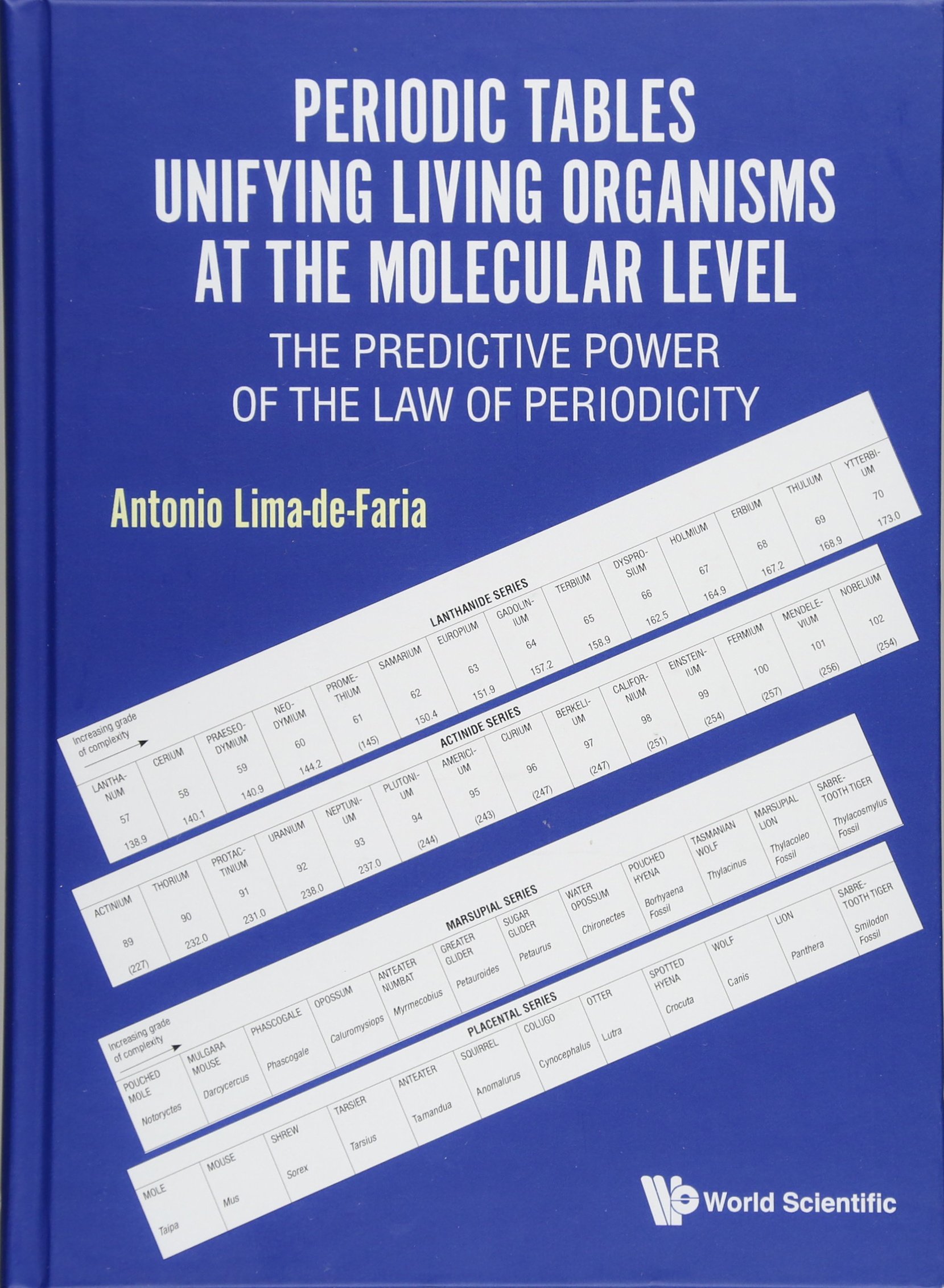
in which he notes:
“Every structure and function is the immediate product of a molecular cascade having its origin in atomic and ultimately in electronic events.”
and
“Minerals and other pure chemicals have no genes, yet they already display these two basic features: constancy of pattern and ability to change it by forming a very large number of forms.”
Lima-de-Faria was especially keen on the European Spallation Source neutron scattering facility being constructed at Lund University, which he thought held great promise in enabling the probing of structure and motion of living matter.
He also published a 10-page review of my 2019 book, Darwin Overthrown: Hello Mechanobiology.
Antonio Lima-de-Faria attributed his long life to a relentless interest in his work. I’m advised that he has another paper now “in press.”
I will truly miss Antonio and am reposting as a tribute to him my review of his book, Science and Art Are Based on the Same Principles and Values, which follows. Antonio regarded the book as his testament:
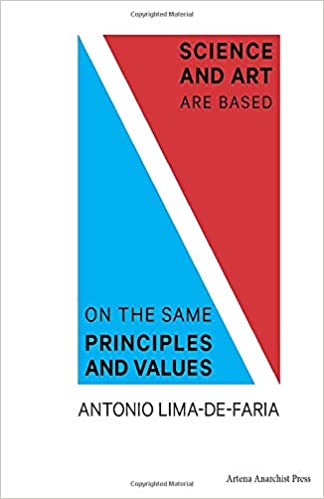
With scientific papers increasingly written by teams of scientists at universities rather than by individual scientists independently researching in their own labs, kitchens, basements, or garages—the result is too often a compromised paper with abstruse language intended to masquerade, to keep the public from knowing how its funds have been wasted while serving to pump up team profiles and H-indexes. It’s a gaming of the system and not a healthy development for science. But author Antonio Lima-de-Faria in his new book, Science and Art Are Based on the Same Principles and Values (Artena Anarchist Press), goes further in his assessment, saying “a wave of obscurantism is spreading over Western countries affecting both science and art in a deadly way.”
Politics, of course, has to be factored in. Obscurantism emanates from political circles whose members are intent on controlling the population (Plato’s Noble Lie). Think Weapons of Mass Deception and Weapons of Mass Destruction. Think P.A.T.R.I.O.T. Act and emergency law. Think Covid politics. It’s especially important to co-opt influential scientists and artists, who provide the bedrock and imagery for our civilization. Think Dolly Parton singing “Vaccine, vaccine, vaccine” to the tune of Jolene.
Antonio Lima-de-Faria is a cytogeneticist and professor emeritus, Lund University, Sweden. He has been decorated by Sweden’s king for his visionary science: “Knight of the Order of the North Star.”
I first became aware of A. Lima-de-Faria’s work through his 1988 landmark book: Evolution Without Selection.
Lima-de-Faria lives on top of a Swedish fjord and in his latest book describes himself as “a lonely wolf howling in the immensityof the night sky.” But it is because after a long, distinguished life in science, and at age 99, he sees the enormity of a crushing of humanity without sufficient public outcry. He thinks the dumbing down of our civilization by technology and its cut & paste digital world has now reached a critical point. However, he argues that we can “stave off” this deadly wave if we urgently look to the principles that have historically enabled human ingenuity.
In his book Lima-de-Faria presents lively vignettes of genius at work through the ages—from Plato, Pliny, and Pythagoras to Verdi, Mozart and Chopin, to Rodin, Matisse, and Picasso, to Einstein, Bell, and Edison (partial list). He doesn’t mention Nikola Tesla, though, who electrified the world. And he doesn’t mention the models of Rodin, Picasso et al. who were crucial to their art.
The complicated personal life of Picasso is widely known. But a recent article in the London Review of Books by artist Celia Paul—who sat for Lucian Freud and is the mother of their son, Frank—lets us in on some of the backstories of Auguste Rodin and painter Gwen John, who was one of Rodin’s models, as well as the backstories of Celia Paul and Lucian Freud.
Paul says this about the relationship of Auguste Rodin and Gwen John:
“She [Gwen John] was 27 when she started to model for him. He was 63. Rodin slept with a lot of women during his lifetime and the women he slept with also posed for him.”
Not surprisingly, Gwen John was tortured by jealousy, but Celia Paul says Gwen John’s art was not dependent on Rodin, even though: “‘Longing’ is the emotion that drives Gwen John’s art.” And, she admits, her own art as well.
Paul says further:
“People don’t become artists if they are sane and well-adjusted. The world is indulgent towards the neurotic male artist. The more impossible his behaviour, the more he is valued. The world disapproves of neurosis in a female artist.”
The backstories of our eminent scientists can be just as messy. Einstein’s personal life for starters. And the more recent cases of star scientists involving sexual harassment and child pornography. One accomplished scientist I interviewed in the late 1970s hanged himself two decades later when child porn was discovered on his computer.
Lima-de-Faria prefers to share the more delightful stories of discovery. He recounts one about Mozart composing Piano Concerto 7 based on the song of a starling.
He also reveals Ivan Pavlov’s recipe for productive science:
“First of all—consistency. Of this important condition of fruitful scientific work I can never speak without emotion.”
Lima-de-Faria says a significant number of those who transformed the world were born in the 19th century and he cites many of them and their work—Jules Verne, Louis Pasteur, Marie and Pierre Curie et al. He notes that some were aristocrats, like Tolstoy, Kropotkin, and even Karl Marx.
Lima-de-Faria, himself was born (1921) into an aristocratic Portuguese family.
He quotes the wisdom of Johann van Goethe:
“He who is and remains true to himself and to others has the most attractive quality of the greatest talents.”
And physicist Linus Pauling, recipient of two Nobel prizes:
“Nowadays we have big physics—million-dollar. . .or billion-dollar physics. Papers are published in ‘Physical Review Letters’ with more than a hundred authors. . .but there is still a good number of people, theoretical physicists and chemists, who continue to work the old way of the individual trying to have an idea that will lead to the solution of some problem.”
Surely, Antonio Lima-de-Faria shares a space with the rogue experimenters he profiles. These bold, highly imaginative thinkers with enormous talent to enlighten and the goal of balancing humanity and ingenuity.

 OSCILLATIONS